
Pinellas County • St. Petersburg • Clearwater • Largo • Dunedin • Seminole • Palm Harbor • Gulfport
Pinellas County remains under Modified Stage 1 Water Shortage rules, meaning most residential irrigation is limited to
one assigned watering day per week. If your lawn is turning brown, you’re not crazy, you’re just living in Florida.
- Why is my lawn dying in St. Petersburg? One-day watering + heat + sandy soil = turf stress, dormancy, weeds.
- What’s the 2026 watering rule in Pinellas County? Modified Stage 1 typically limits irrigation to 1 day/week.
- What actually works? Transition from high-water turf to drought-tolerant Florida-native landscaping.
Pinellas County Stage 1 Water Restrictions (Effective Late 2025 / Early 2026)
Pinellas County has been operating under Modified Stage 1 Water Shortage guidance,
which typically limits most residential irrigation to one assigned watering day per week.
These restrictions affect homeowners across the county, including:
St. Petersburg, Clearwater, Largo, Dunedin,
Palm Harbor, Seminole, and Gulfport.
The goal is to reduce outdoor water demand during dry conditions and protect regional water supply.
The problem is simple: traditional Florida lawns are not built for low-water rules.
We routinely hear homeowners say they’ve had to re-sod every few years even when watering “correctly.”
If you’re in St. Pete, Clearwater, South Pasadena,
Pinellas Park, Safety Harbor, or anywhere along the coastal corridor,
your lawn is also dealing with salt exposure, wind, and fast-draining sandy soil.
That combo makes one-day irrigation feel even harsher.
Pinellas County 1-Day Watering Schedule (St. Pete & Clearwater)
Many residents search for “official watering schedule” because enforcement and allowances can vary by municipality.
Use this section as your quick reference and update the day mapping to match your local utility notices.
| Area | Typical Rule Under Modified Stage 1 | Assigned Day | Best Practice |
|---|---|---|---|
| St. Petersburg | 1 day/week residential irrigation | [Insert St. Pete assigned day] | Water early morning, avoid midday loss, deep soak where allowed |
| Clearwater | 1 day/week residential irrigation | [Insert Clearwater assigned day] | Use micro-irrigation for beds, minimize overspray on pavement |
| Other Pinellas Cities (Largo, Dunedin, Seminole, etc.) | Often similar 1 day/week limits | [Insert your city’s day] | Use mulch + drought-tolerant plants to reduce demand |
Tip: If your city posts amendments (new times, reclaimed water rules, new plants establishment exemptions),
add them here and update your FAQ. Google rewards freshness on “rules/schedule” queries.
Why Your Lawn Is Struggling Under 1-Day-Per-Week Watering
Traditional turfgrass in Pinellas County is a thirsty system. Even St. Augustine (commonly used here)
is essentially a wetland-adapted grass. When irrigation drops to one day per week, you get predictable results:
- Root zone dries out fast in sandy soil
- Grass goes dormant earlier and stays brown longer
- Weeds move in as turf thins and bare soil opens up
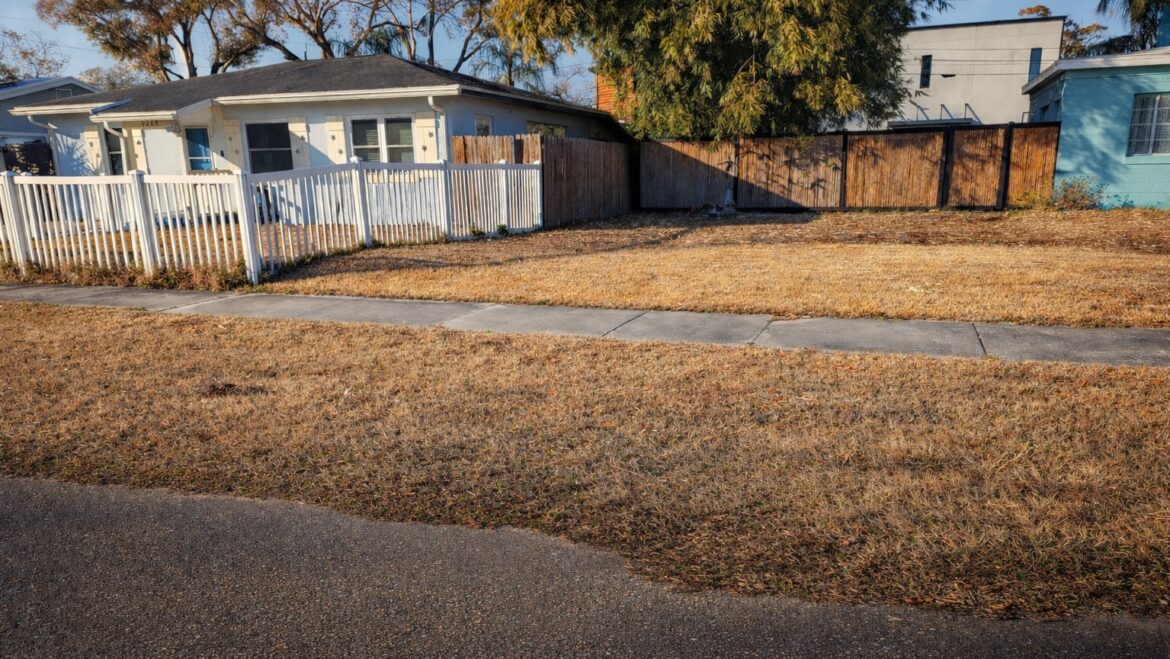
- Brown patches expand especially near sidewalks and street heat
Even if you water perfectly on your assigned day, it often is not enough. You’re trying to keep a high-maintenance plant alive under low-water rules.
That mismatch is the real problem.
The Financial Hit: Your Water Bill vs. Your Lawn
Homeowners rarely price out the true cost of “keeping the lawn alive”:
watering, fertilizing, fungicides, patching, and eventually full replacement.
Outdoor irrigation can represent a major slice of residential water use in Florida, especially in dry stretches.
Why native landscaping wins financially
- Lower irrigation demand after establishment
- Less replacement cost (no recurring “re-sod cycle”)
- Reduced maintenance compared to turf rescue routines
- Less stress during restriction updates and dry seasons
Even if you use well water, the pump still costs electricity and draws from the aquifer. Water-smart landscaping helps your bills and the ecosystem.
What Actually Works: Drought-Tolerant Native Landscaping in Pinellas County
The best long-term solution is not “watering harder.” It’s designing your yard to match reality:
Pinellas County water rules + Florida heat + sandy soil.
Florida-native plants evolved here and handle:
- Sandy soil and drainage
- Salt air (especially coastal St. Pete and Clearwater)
- Long dry stretches followed by heavy rain
- Heat stress and reflective street/sidewalk temperatures
Once established, many native plants require little to no supplemental irrigation beyond normal rainfall.
That means your landscape keeps looking intentional even during Stage 1 restrictions.
Three Native Plants That Thrive in Pinellas (St. Pete + Clearwater Proven)
Coontie (Zamia integrifolia)
A tough, clean, structured Florida native that handles drought and looks “designed” without constant attention.
- Extremely drought tolerant once established
- Works in sun or partial shade
- Minimal maintenance, long-lived
- Great for modern, low-water beds
Saw Palmetto (Serenoa repens)
Ideal for coastal Pinellas properties. Bold texture, strong drought resistance, and a true Florida identity.
- Highly drought resistant
- Salt tolerant (coastal-friendly)
- Wildlife supportive
- Low maintenance, long-lasting
Muhly Grass (Muhlenbergia capillaris)
Soft texture, big seasonal color. If you want beauty without becoming a sprinkler accountant, this is a winner.
- High drought tolerance
- Famous pink blooms in fall
- Movement and texture for curb appeal
- Minimal watering once established
What a Drought-Tolerant Yard Means for You
- Predictable water bills (less irrigation dependency)
- Less stress during restriction updates
- Reduced maintenance compared to turf rescue
- Long-term resilience during heat and dry stretches
- Better curb appeal with intentional design instead of patchwork grass
Most importantly: you stop fighting the county’s water policy every dry season.
Stop Trying to Save a Lawn That Wasn’t Built for This
Pinellas County water restrictions aren’t a one-off inconvenience. They’re part of a pattern.
If your lawn keeps failing, it’s not because you’re “bad at watering.” It’s because the yard was designed for a water budget that no longer exists.
FAQ: Pinellas County Water Restrictions & Lawn Care
Why is my lawn dying in St. Petersburg even though I water on my day?
One day per week often cannot replace moisture lost to heat, wind, and sandy soil. Turf thins, roots dry out, weeds move in, and brown patches spread.
What are the 2026 Pinellas County watering rules?
Under Modified Stage 1, most residential irrigation is typically limited to one assigned day per week. Exact times and exemptions may vary by municipality.
What grass survives best with water restrictions in Clearwater?
In many cases, the better answer is not “a different grass,” but a lower-water landscape plan: drought-tolerant natives, mulched beds, and targeted micro-irrigation.
What is the cheapest long-term fix?
Stop re-sodding and stop feeding turf inputs into a restriction cycle. Transition problem areas to drought-tolerant native beds and reduce the irrigated footprint.
Book a Drought-Proof Design Consultation with Wise Hands
If you’re in Gulfport, St. Petersburg, Clearwater, Largo,
Dunedin, Pinellas Park, or anywhere in Pinellas County,
Wise Hands designs Florida-native landscapes built to thrive under water restrictions.
- On-site property evaluation
- Water-efficient planting strategy
- Native plant selection for sun/shade + soil conditions
- Long-term maintenance planning
- Budget-conscious design options
Plant what is meant to thrive here. Stop gambling with your lawn every dry season.